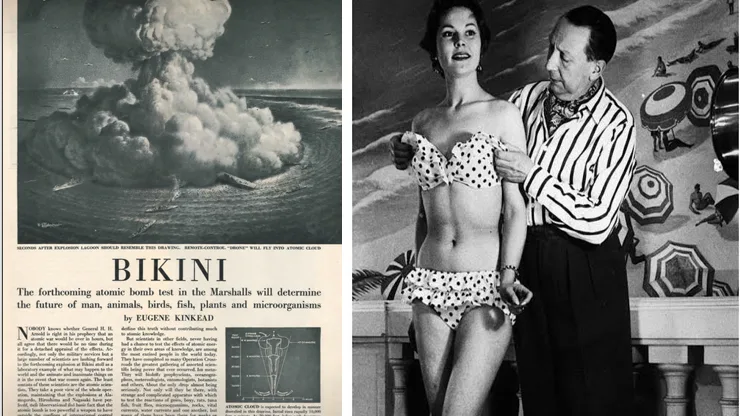
If you think the word bikini was coined for a garment worn in the sea, its story may surprise you. Because this name was not born in a designer’s studio. It was taken from Bikini Atoll in the Marshall Islands of the Pacific Ocean. The United States’ nuclear test conducted there on July 1, 1946 inspired the name of a swimsuit that would be unveiled a few days later.
Four days later in Paris…
French engineer and designer Louis Réard unveiled his new swimsuit on July 5, 1946 at the Piscine Molitor in Paris. Two-piece swimsuits were already in use; what set Réard’s design apart was that it used much less fabric and left the navel exposed. In terms of the era’s approach to dress, this was a rather bold step.
It was not easy to find a professional model to showcase the design, either. When models refused to wear this tiny swimsuit, Réard reached an agreement with Micheline Bernardini, a dancer at the Casino de Paris. Thus Bernardini became the person who introduced the new design to the public.
One said “atom,” the other “bikini”
That summer there was a race to attract attention in the world of swimwear. French designer Jacques Heim had named his own two-piece swimsuit Atome, the French word for “atom,” and promoted it as the world’s smallest swimsuit.
Réard responded with an even smaller design. He chose his name from Bikini Atoll, which had come to the fore with the nuclear tests. According to the Smithsonian, he also claimed his design would have an “explosive” impact on the public. Thus the vocabulary of the nuclear age became part of swimsuit advertising as well.
Over time, the name that endured was “bikini.” The word went beyond Réard’s design and became a generic term for similar two-piece swimsuits. Behind this word, which today evokes beaches and summer holidays, lies a Pacific atoll that entered the world agenda through nuclear testing.