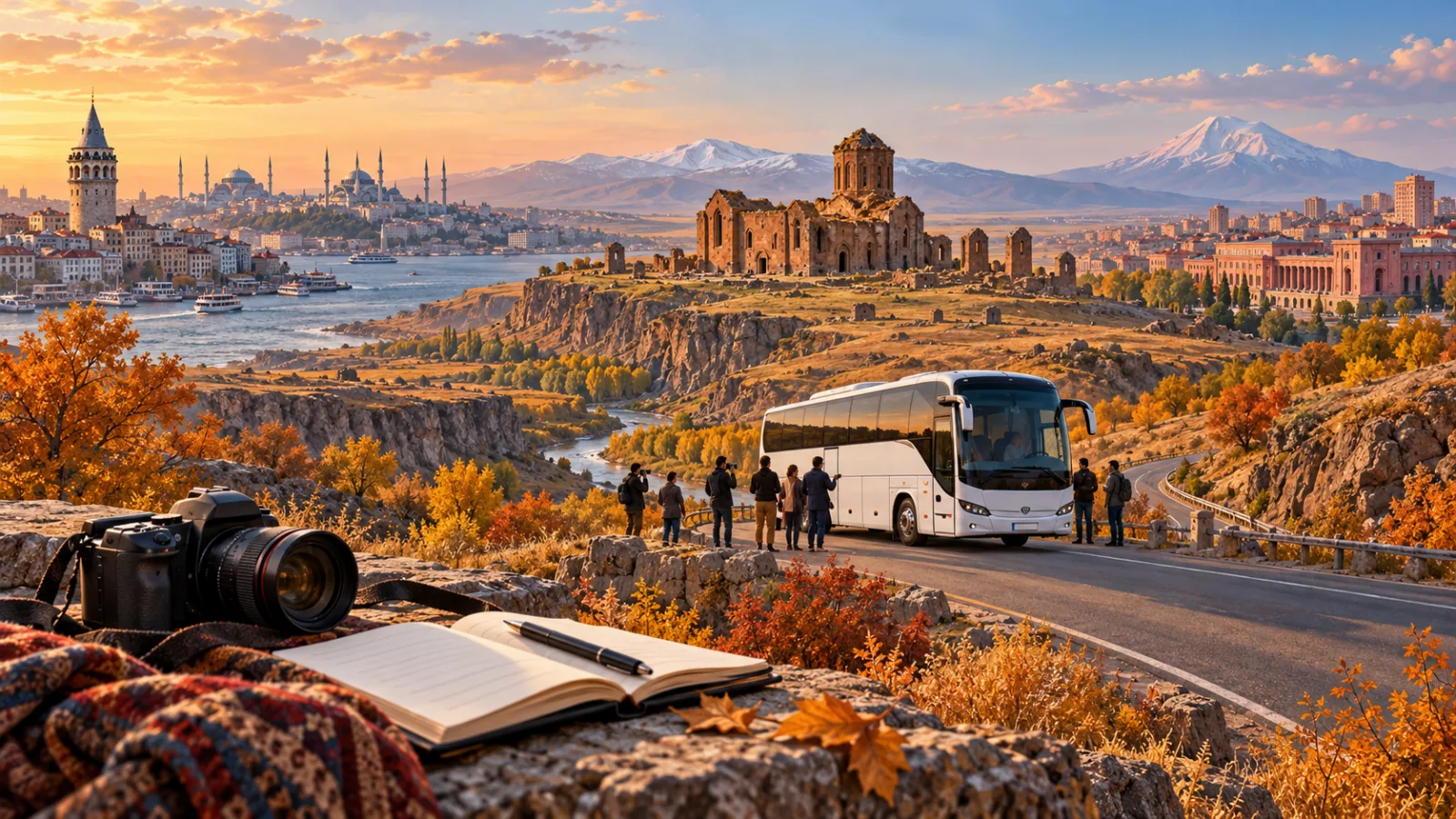
Bringing together journalists and media professionals from Armenia and Turkey, the “Media Bus Tour” is being held as part of a program prepared for 12–26 October 2026. The study visit’s first leg is in Turkey and the second in Armenia, offering participants the opportunity to examine economic, cultural, and social relations between the two countries in the field.
Partners in the initiative, carried out with the support of the European Union within the framework of the “Support to Armenia–Turkey Normalisation: Strengthening Cross-Border Ties” program, include the Eurasia Partnership Foundation (EPF), the Union of Manufacturers and Businessmen of Armenia (UMBA), the Economic Policy Research Foundation of Turkey (TEPAV), and the Hrant Dink Foundation.
Stops on the journey from Istanbul to Yerevan include Izmir, Diyarbakir, the Suluk Bridge in Mus, Van, the historic city of Ani, and Gyumri. The route reported by Armenia’s Public Radio is associated with hubs along the historic Silk Road. In addition to a visit to the Agos newspaper’s headquarters, the program also foresees meetings with local producers and businesses.
The aim is for journalists to hear local experiences firsthand and to explore opportunities for economic cooperation, tourism, and people-to-people contact. Meetings with business representatives, researchers, and educational and civil society institutions are expected to help make diverse perspectives more visible in coverage related to both countries.
According to Armenia’s Public Radio, the group is scheduled to reach Gyumri by road on 18 October. Visits in Yerevan will present the work of TUMO and Picsart and introduce initiatives in the field of artificial intelligence. The report notes that the tour’s final stop will be the exhibition area within the scope of COP17. COP17, to be held in Yerevan on 19–30 October, will take place as the 17th Conference of the Parties to the United Nations Convention on Biological Diversity.
The joint journey aims to enhance professional dialogue among journalists and to overcome entrenched stereotypes regarding the everyday lives of the two societies. Participants are expected to convey their field observations to the public through fact-based, balanced, and multidimensional reporting.