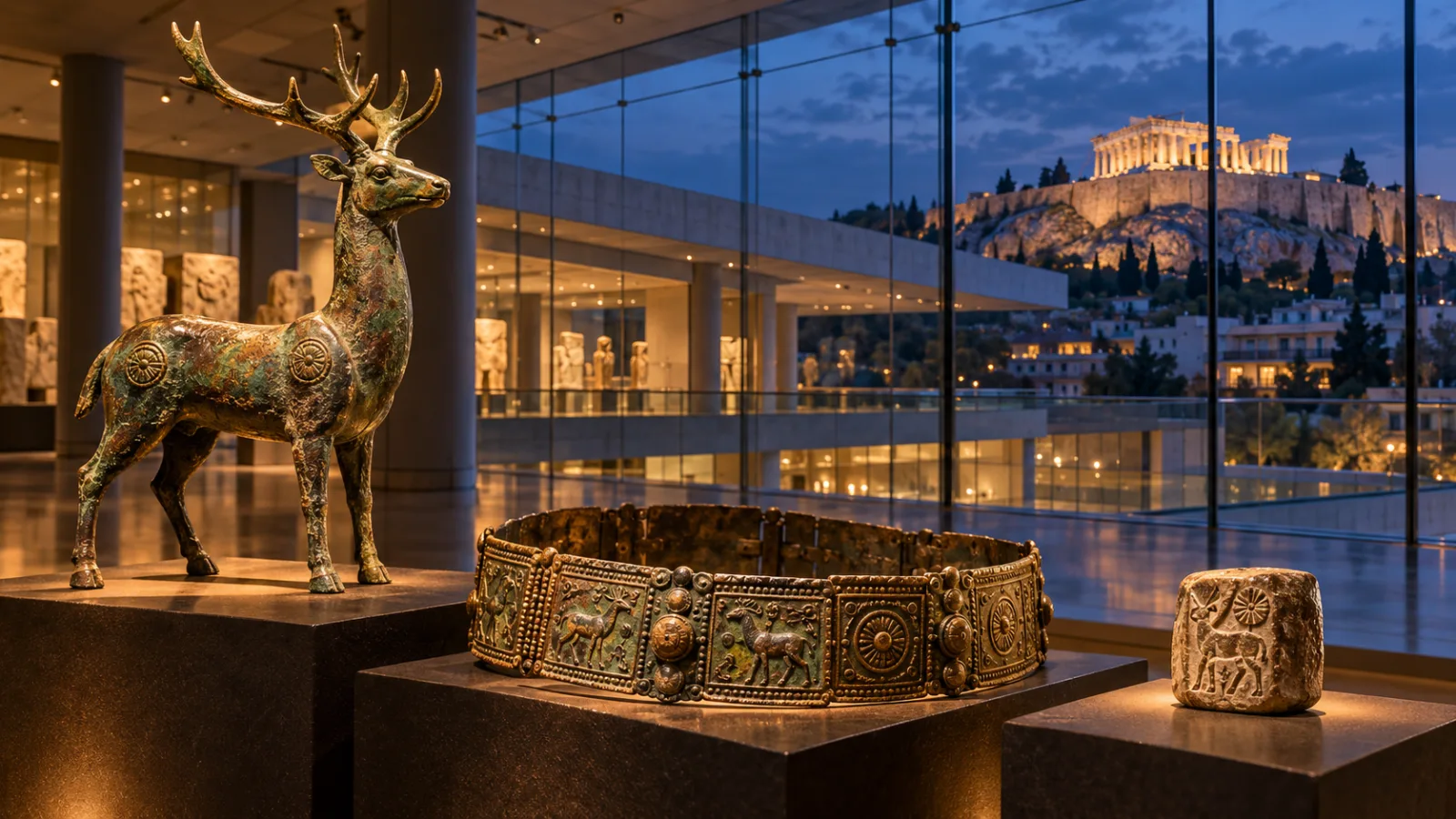
The “Ancient Armenia” exhibition to open at the Acropolis Museum in Athens will cover a broad period from the Stone Age to the adoption of Christianity. Bringing together around 200 archaeological artifacts, the exhibition will present, in addition to the Urartian period, Armenia’s historical ties with Greece and the Mediterranean world.
Armenia’s cultural heritage spanning from prehistoric times to antiquity is being brought to Athens, the capital of Greece. Prepared in collaboration between the History Museum of Armenia and the Acropolis Museum, the “Ancient Armenia” exhibition will recount the region’s millennia-long past through archaeological artifacts.
According to the Acropolis Museum’s official program, the exhibition will be open to visitors from 20 November 2026 to 28 February 2027 and will be the inaugural event in the museum’s new series of exhibitions aimed at introducing ancient civilizations.
Focus on the pre-Christian past
Armenia’s cultural heritage is most often presented in international exhibitions through works associated with the history of Christianity. “Ancient Armenia” aims to make visible the older layers of this heritage.
The historical framework of the exhibition will begin with the Paleolithic and encompass the Bronze Age, Early Iron Age, Archaic, Classical, Hellenistic and Roman periods. The narrative will extend to the 4th century CE, when Christianity began to assume a defining place in Armenia’s cultural life. In this way, visitors will be able to follow the region’s long history by seeing finds from different eras within a single exhibition.
More than 170 works from the History Museum of Armenia
Dr. Nzhdeh Yeranyan, Deputy Director for Scientific Affairs at the History Museum of Armenia, announced that more than 170 works from the museum’s collection will be on display at the Acropolis Museum for approximately three months.
Yeranyan noted that appearing in a museum that attracts large numbers of international visitors is important for the recognition of both the institution and Armenia. An illustrated book will also be published in conjunction with the exhibition.
The Acropolis Museum’s announcement states that the exhibition will comprise approximately 200 archaeological artifacts in total.
Urartian period at the heart of the exhibition
A special place will be dedicated to the Urartian period. The archaeological legacy of this period will provide a window into the cultural interactions of the Early Iron Age in the region.
Through the objects, connections with the Near East, the Eastern Mediterranean, Cyprus, Crete and the Aegean world will be explored. By making these relationships visible, the exhibition seeks to contextualize the region’s history alongside the civilizations that surrounded it.
Historical relations between the Armenian and Greek worlds
“Ancient Armenia” will also focus on the ties between Armenia and Greece that reach back to antiquity. Yeranyan said the exhibition aims to convey the nature of these bonds to both residents of Greece and foreign visitors.
Organized following a memorandum of cooperation previously signed in Greece between the two museums, the event will bring together the institutions’ collections and scholarly expertise in a joint exhibition.
International museum collaborations expand
The Athens exhibition is part of the international initiatives developed in recent years by the History Museum of Armenia. In the exhibition “Mother Goddess: From Anahit to Mary,” organized in cooperation with the British Museum, the bronze head and hand of the goddess Anahit were presented to visitors alongside other works.
The exhibitions “Sacred Dialogues,” prepared with the Louvre Museum, and “Myths, Cults and Cosmology,” opened in Yerevan in collaboration with Berlin’s Museum Island, are also among these initiatives.
Another pillar of the museum’s international program is Cyprus. Opened on 9 October at the Byzantine Museum of the Archbishop Makarios III Foundation in Nicosia, the exhibition “Faith and Identity: Works from the History Museum of Armenia” addresses the shared Christian heritage of Armenia and Cyprus. Four works selected from the collection represent different aspects of Armenian culture, church art and state tradition.
Yeranyan emphasizes that such events strengthen the exchange of knowledge and experience between museums while also contributing to the development of cultural relations between countries.
Visitor information
“Ancient Armenia” will be held in the Temporary Exhibition Gallery on the ground floor of the Acropolis Museum. Admission will be free during museum opening hours; visitors will need to obtain a free entry ticket at the ticket office. The information texts will be provided in Greek and English.