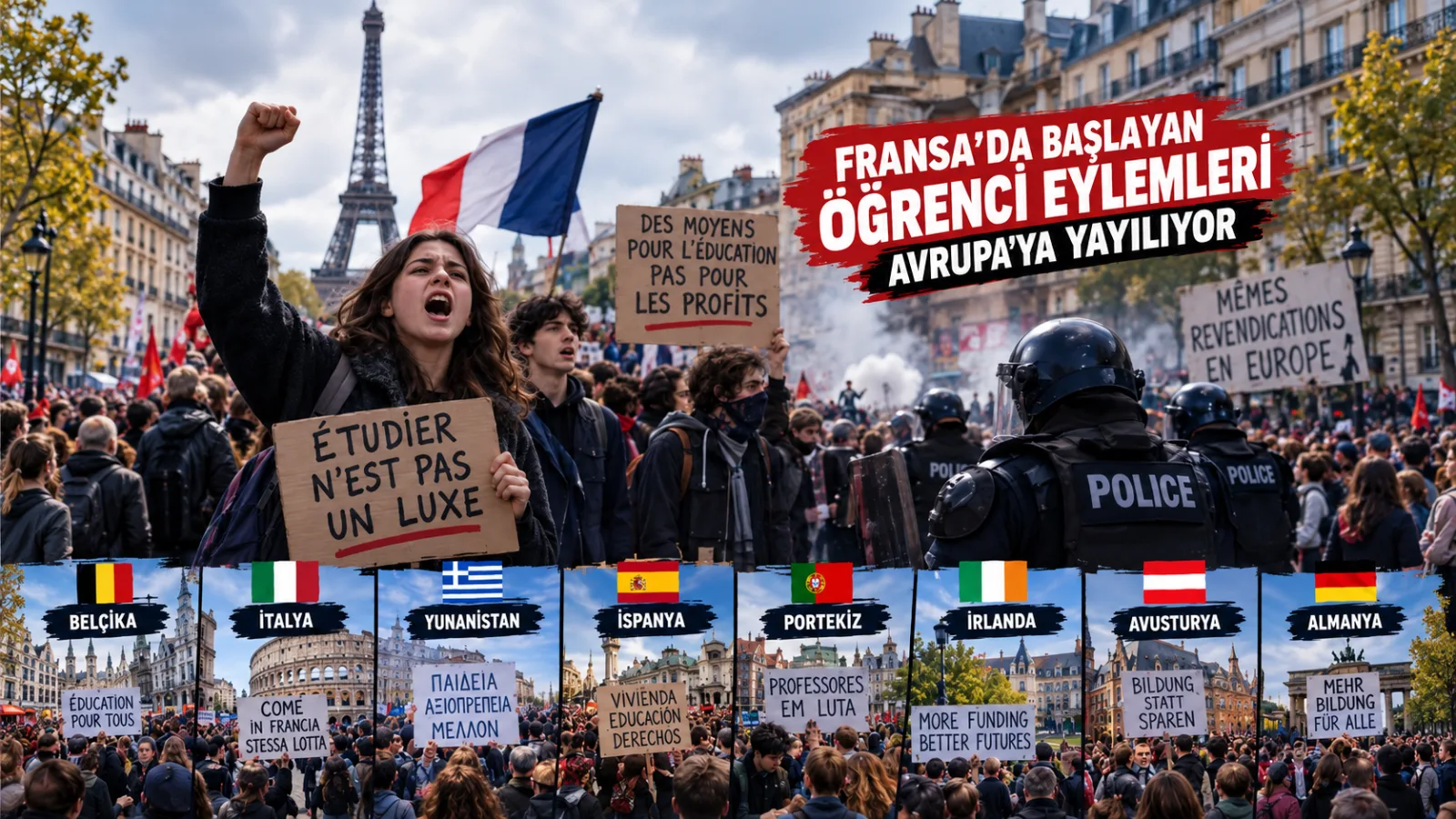
Protest reports from different European countries are bringing students’ and workers’ demands—from education to housing—onto the agenda. While the reasons and participants vary by country, police interventions and damage to public property in some cities are also being debated.
In France, reactions over education conditions are reported to have broadened to include objections to the cost of living and the government’s budget policies. Teachers, parents, and trade unions are supporting the students’ demands.
In France, students’ demands center on education conditions
A shortage of teachers, overcrowded classrooms, and aging school buildings are among the main reasons behind the student protests in France. While most of the student actions that have continued for weeks have been peaceful, clashes with security forces have occurred at some demonstrations.
New protests against the cost of living and fuel prices are planned for 17 October, and students are expected to join them. Thus, grievances in the field of education and reactions to living conditions have found expression on the streets at the same time.
Police interventions are also at the center of the debate
In France, not only the damage incurred during the demonstrations but also the methods of police intervention have come under scrutiny. Interior Minister Laurent Nuñez announced that 36 investigations had been opened into allegations of police violence at student protests. It was stated that some of the files involve allegations of serious injuries and permanent disability.
President Emmanuel Macron, in a statement ahead of the demonstrations, said the right to protest is respected and called for no harm to people or property.
Macron condemned attacks on workplaces and public buildings and called for those responsible to pay for the damage.
In Albania, students put education and housing issues on the agenda
In Tirana, the capital of Albania, students gathered in front of the Ministry of Education to demand improvements in education conditions. Citizens joined the demonstrations alongside students.
Students complained of insufficient investment in universities, high rents, and a shortage of student dormitories. Updating what they described as an outdated curriculum was also among the demands. Seeking government support to solve the problems they face throughout their education, the students decided to continue their demonstrations.
It was reported that during the action some protesters threw incendiary materials at the ministry building and nearby businesses, and that trash containers were set on fire. Police intervened with tear gas and water cannon, and protesters were reported injured.
Education spending in Belgium, government policies in Italy
At the demonstrations in Belgium, objections focused on education financing, tuition and transportation costs, and austerity policies. It was reported that, in addition to students, teachers, workers, and parents took part, and that police intervened in some of the actions.
In Italy, students in cities such as Milan, Rome, and Turin protested the government’s education policies. Demands for more resources for public schools were voiced through marches, class boycotts, and school occupations.
Housing and wages come to the fore in Portugal
In Portugal, trade unions and housing-rights advocates are playing a prominent role in the demonstrations. Reports from Lisbon, Porto, and Coimbra highlight high rents, difficulties in accessing housing, wages, and pensions. Protesters are also demanding the protection of public services.
Across different countries, the demands show similarities around issues of education and livelihoods. However, the reports examined do not indicate that all the demonstrations are organized from a single center or that they stem directly from the actions in France. Each protest needs to be assessed within its own demands and conditions.