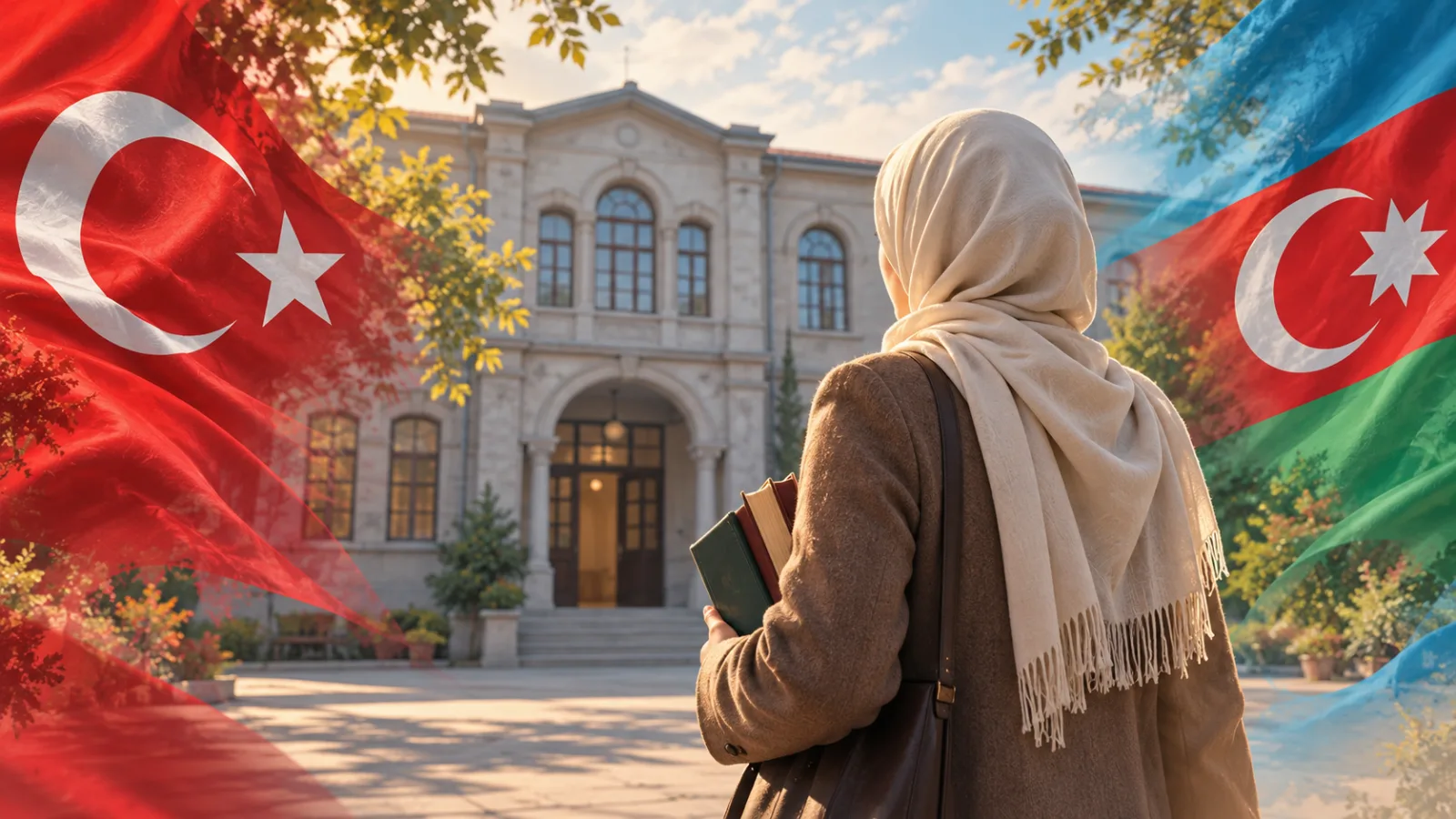
Reports that headscarved students and teachers were not being admitted to schools in Azerbaijan led to reciprocal statements between Turkey and Azerbaijan. After Chief Advisor to the President Oktay Saral and some AK Party lawmakers reacted to the practice, the ruling New Azerbaijan Party (YAP) in Azerbaijan deemed the criticism an intervention in the country’s internal affairs.
Ermenihaber’s article on the issue examines the debate through the lens of differing understandings of sovereignty and political approaches between two close allies. The piece assesses that relations defined by historical and cultural ties may encounter sensitive boundaries when it comes to divergences over domestic policy.
At the origin of the debate lies a regulation adopted by Azerbaijan’s Cabinet of Ministers on September 21 concerning student attire in public schools. The regulation does not explicitly mention the headscarf; it imposes restrictions on additional garments said to disrupt the integrity of the school uniform and to be incompatible with a secular approach to education. News and footage from some schools showing headscarved students being denied entry intensified reactions to the implementation.
Rules regarding teachers’ attire adopted on October 6 were also added to the discussion. According to Medyascope, English teacher Gülşen Aliyeva, who said she and her daughter were barred from school because of the headscarf, stated that she might seek legal action to continue her profession. Zahid Oruj, Chair of the Human Rights Committee of Azerbaijan’s Milli Majlis, argued that the practice does not aim at religious discrimination but seeks to uphold common dress rules in the educational environment.
One of the reactions from Turkey to the practice came with Chief Advisor to the President Oktay Saral’s social media post on October 12. Stating that he found it unacceptable to deprive headscarved students of education, Saral called for the policy to be reversed. AK Party Deputy Group Chair Leyla Şahin Usta and AK Party MP Muhammet Müfit Aydın also voiced their criticism.
In response, YAP, in a statement dated October 13, accused Saral and AK Party lawmakers of failing to consider Azerbaijan’s constitutional order and the foundations of its education policy. The party also claimed that the broadcasts of some media outlets in Turkey were increasing tensions between the two countries’ publics.
In its statement, while emphasizing Azerbaijan’s secular state structure, YAP recalled that the principle of secularism is also enshrined in Turkey’s constitution. Arguing that education rules are implemented on the basis of equality and equal opportunities, the party opposed turning the headscarf issue into a tool of political pressure on Azerbaijan.
One notable part of the statement was the interpretation of the phrase “One nation, two states,” which defines relations between the two countries. YAP stated that this principle rests on the existence of two independent states; it cannot serve as a pretext for one state to interfere in the other’s internal affairs or to impose its political and ideological approaches. Thus, the response to the headscarf debate highlighted equality between states and the right to make independent decisions.
As the debate continued, MHP Chairman Devlet Bahçeli also emphasized respect for sovereignty and domestic law in a written statement on October 14. Noting that cooperation among Turkic states develops on the basis of independence, equality, and common interests, Bahçeli called for prudence and mutual understanding in relations between Turkey and Azerbaijan.
Bahçeli’s statement showed that political actors in Turkey approached the issue with varying emphases. While some AK Party representatives highlighted the right to education and freedom of belief, Bahçeli stressed respect for states’ internal regulations and sovereign rights.
Relations between Azerbaijan and Israel also appeared in the reciprocal statements. While YAP argued that these relations are conducted on the basis of international law and mutual interests, it stated that it supports the rights of the Palestinian people and a two-state solution. The party rejected political accusations directed at Azerbaijan over its ongoing relations with Israel.
On the diplomatic agenda is the Organization of Turkic States summit, planned to be held in Ankara on October 30. President Recep Tayyip Erdoğan and Azerbaijani President Ilham Aliyev are expected to meet on the sidelines of the summit. Statements made ahead of the meeting increase interest in how the two countries will address the increasingly visible differences of opinion in public while maintaining close cooperation.