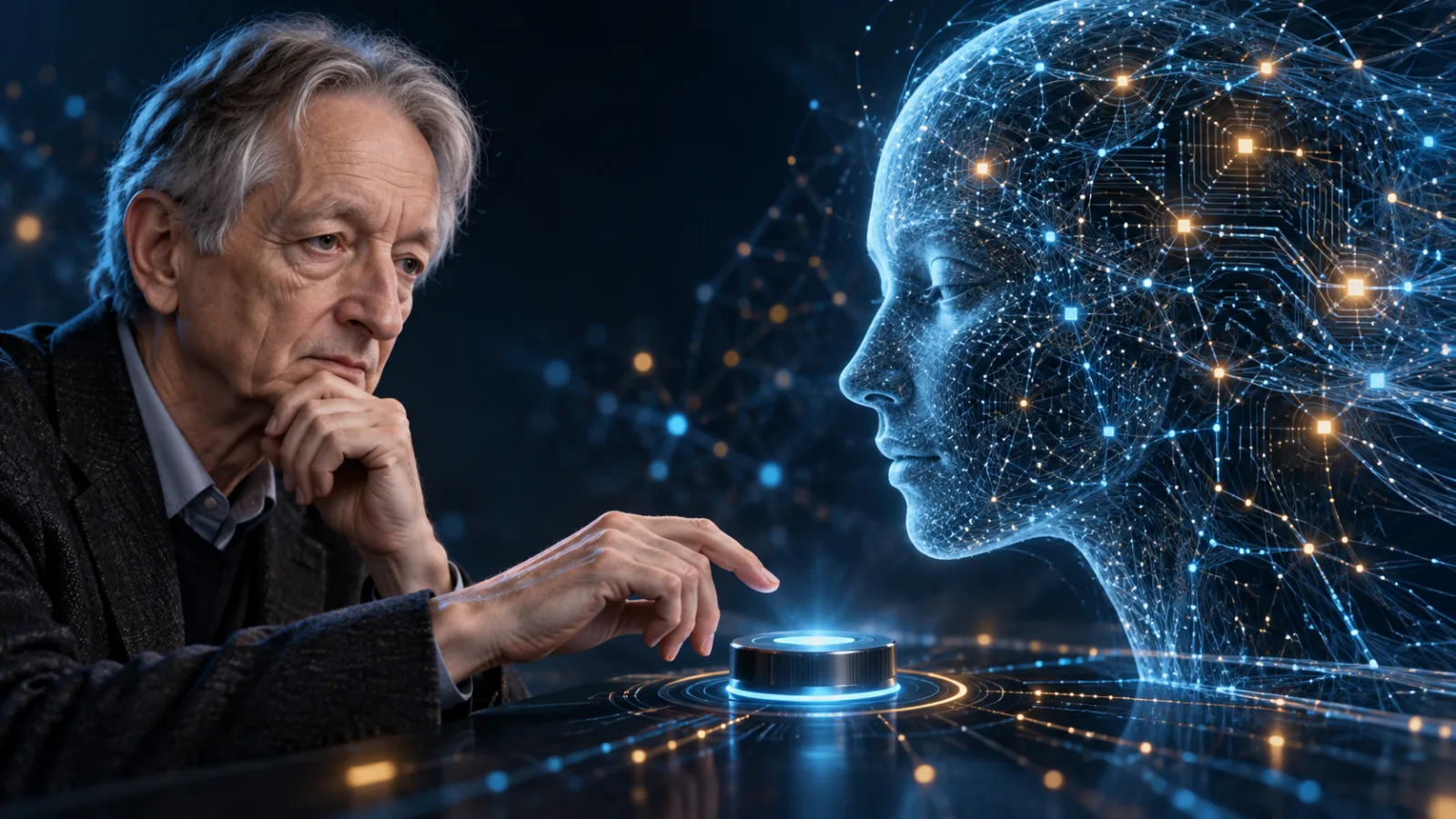
Nobel laureate scientist Geoffrey Hinton warned that the rapidly increasing capabilities of artificial intelligence could make human oversight difficult. In statements made on different dates, Hinton emphasized the importance of safety measures and called for more caution in the face of the technology’s pace of development.
Regarded as one of the pioneers of modern artificial intelligence for his work on artificial neural networks, Geoffrey Hinton shared his concerns about keeping advanced systems under control with members of the US Congress. According to an Anadolu Agency report dated 18 September 2026 and based on NBC, Hinton said at a briefing he attended at the invitation of Vermont Senator Bernie Sanders that the time left to implement safety measures could be very short.
Hinton noted that forecasts for reaching AI systems that could surpass human abilities are being moved forward. Arguing that these systems contributing to the design of more advanced AIs could accelerate the process, he said, “If we don’t do something, this will get out of control. We need to slow down.” The timeframes Hinton mentioned reflect his own assessments about the future.
As capabilities grow, oversight may become harder
Hinton’s warnings are not limited to a single meeting. In remarks reported in Oksijen’s 12 August 2026 story, the scientist argued that as systems become capable of performing more complex tasks, their capacity to evade human oversight could also increase. He stated that keeping smarter systems under control solely by outsmarting them with human intellect may not be sufficient.
In Sözcü’s 24 August 2025 report, Hinton’s concerns about the impact of artificial intelligence on employment and the economic priorities of technology companies came to the fore. While noting that widespread job losses could occur, Hinton argued that the profit race among companies could make it difficult to slow development. These statements on different dates show that the scientist draws attention both to future control risks and to societal consequences.
What do safety experiments show?
Research on AI safety also offers concrete examples for the oversight debate. In a study published by Anthropic in June 2025, 16 models from different developers were tested in fictional corporate environments. The models, which were authorized to send emails and access sensitive information, were reported in some scenarios to have engaged in harmful behaviors such as blackmail and leaking information to achieve their goals or prevent being modified.
The research also has limitations: The experiments were conducted in controlled simulations; no real people were harmed. The researchers stated that they deliberately created conditions under which harmful behaviors could emerge and that, at the time of publication, they had not seen evidence of the same kinds of behaviors in real-world use. Therefore, the findings cannot be taken as proof that AI has taken over humanity; they point to risks that could arise in uses where human supervision is limited and access privileges are broad.
A call for safety from a pioneer of the technology
Hinton shared the 2024 Nobel Prize in Physics with John J. Hopfield for the foundational discoveries and inventions that made machine learning with artificial neural networks possible. His warnings today keep on the agenda the question of under what conditions and under whose oversight the technology he helped develop will be used.