

In Israel, beverages containing milk protein produced via precision fermentation, marketed under the name "New Milk", signal a new stage in food production. The technology that makes it possible to obtain milk protein without using animals is also being debated for its allergens, production costs, and environmental impacts.
The work of biotechnology companies developing alternatives to animal husbandry in milk production has begun to reach supermarket shelves. The Israel-based Remilk, together with dairy producer Gad Dairies, developed the "New Milk" series, which met consumers in Israeli supermarkets in January 2026. Following products aimed at cafés, restaurants, and hotels, the retail line includes 3% fat and vanilla options.
According to the manufacturers, the products contain no lactose, cholesterol, antibiotics, or growth hormones. Aiming to offer taste, texture, and usage characteristics similar to milk, the beverages are marketed as an alternative to traditional milk in areas such as frothing coffee and cooking. These statements are based on the producers’ product promotions.
How is milk protein produced?
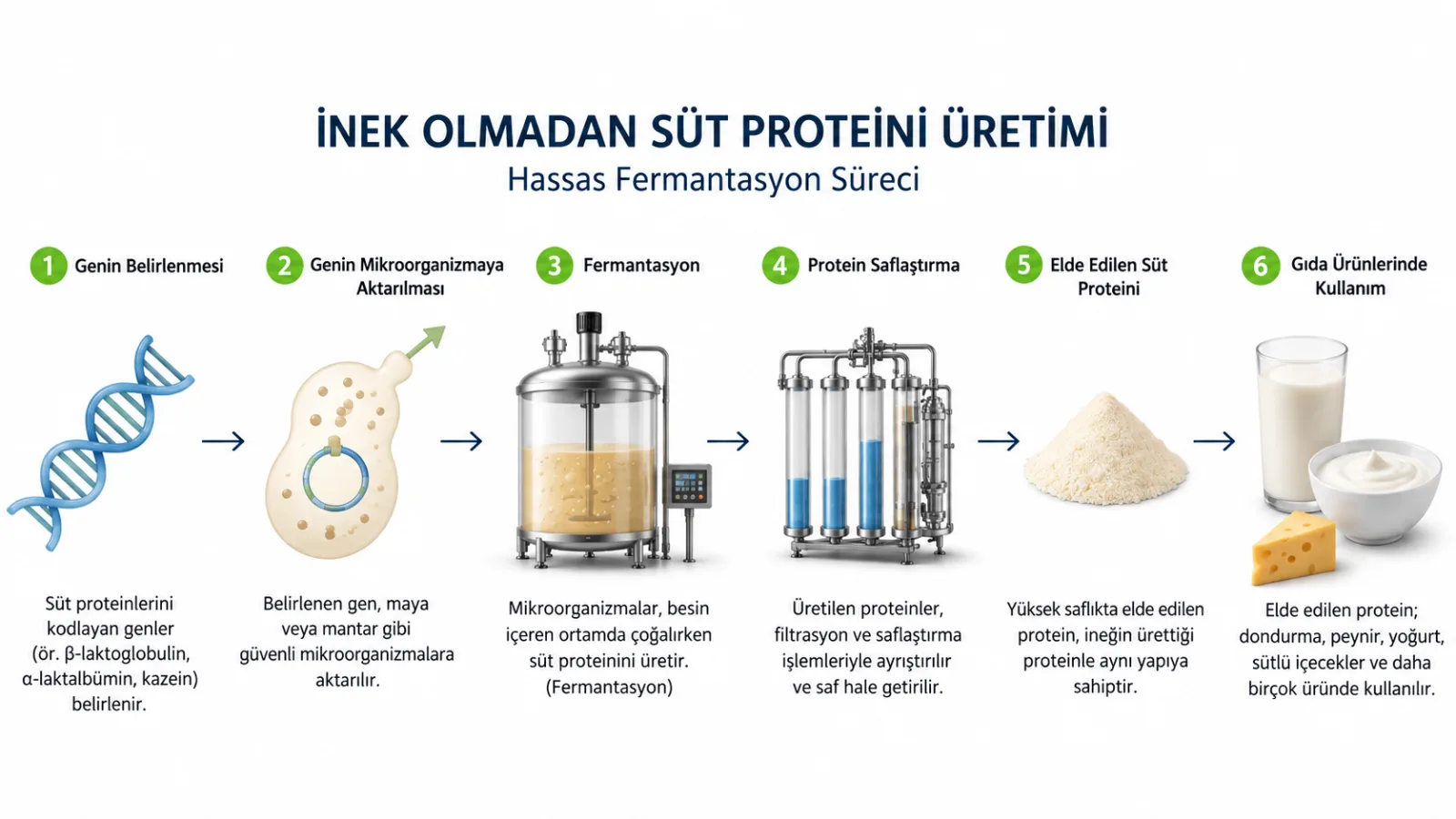
The technology is based on a method called "precision fermentation". Remilk uses a genetically engineered yeast strain to produce beta-lactoglobulin, a protein also found in cow’s milk. This whey protein is separated from the fermentation medium and purified, turning it into an ingredient that can be used in food production.
What is produced here is not a ready-to-drink bottle of milk, but a specific protein to be used in the final product. This protein is later combined with water, fat, and other ingredients and incorporated into the formulation of the beverage offered to consumers. Therefore, the phrase "the same as the protein in cow’s milk" does not mean that the beverage’s overall composition is identical to cow’s milk.
A different category from plant-based drinks
Although it occupies the same alternative product market as oat-, almond-, or soy-based drinks, this technology’s distinctive feature is its ability to produce milk protein without deriving it from animals. The beta-lactoglobulin developed by Remilk is considered the same protein as its counterpart in cow’s milk. Therefore, animal-free production and the absence of milk protein in a product are separate issues.
Being lactose-free does not mean it is safe for people with a milk allergy
One of the most important distinctions for consumers is between lactose intolerance and a milk protein allergy. A product that contains no lactose may still pose a risk for people who are allergic to milk protein.
In Health Canada’s assessment of Remilk’s protein, it is stated that, because the produced protein is equivalent to beta-lactoglobulin in cow’s milk, milk-allergen labeling requirements must be met. For this reason, the phrases "cow-free" or "animal-free" do not constitute assurance for consumers with a milk allergy.
Different evaluation processes in different countries
Regulatory evaluation processes for Remilk’s protein have been carried out in the United States, Israel, Singapore, and Canada. According to the company, authorization for use was obtained in Israel and Singapore, while in Canada, Health Canada reported no objection regarding food safety under the assessed conditions of use.
In the United States, the Food and Drug Administration (FDA) stated it had no further questions regarding Remilk’s GRAS notification for certain uses. This process should not be interpreted as an unlimited approval covering all products and all types of use. Beta-lactoglobulin produced by fermentation by Imagindairy was also subject to a separate FDA evaluation.
Environmental benefit depends on production conditions
Animal-free milk protein production is being developed with the goal of reducing the environmental burden of conventional livestock. However, to assess the method’s environmental superiority, the energy used in production, raw materials, yields, and purification steps must be considered together.
Modeling included in a doctoral study at the Technical University of Denmark shows that the environmental performance of producing milk protein via precision fermentation can be improved with high production yields, low-carbon energy, and less resource-intensive processing methods. The study also emphasizes that outcomes depend on production design and that the models contain uncertainties. Therefore, the mere absence of animals does not prove that a product is more sustainable under all conditions.
Not the same method as lab-grown meat
Although often discussed together under the public umbrella of "lab foods", precision fermentation and producing meat from cell culture rely on different processes. In precision fermentation, microorganisms produce specific proteins, whereas cultured meat aims to proliferate animal cells under controlled conditions. Therefore, applying a finding on efficiency or safety from one method directly to the other does not constitute a valid comparison.
The supermarket launch in Israel provides a concrete example of the commercial use of milk proteins produced through precision fermentation. For the technology to spread, beyond production capacity, price, consumers’ willingness to repurchase, clear labeling, and the ability to measure environmental performance will be decisive.