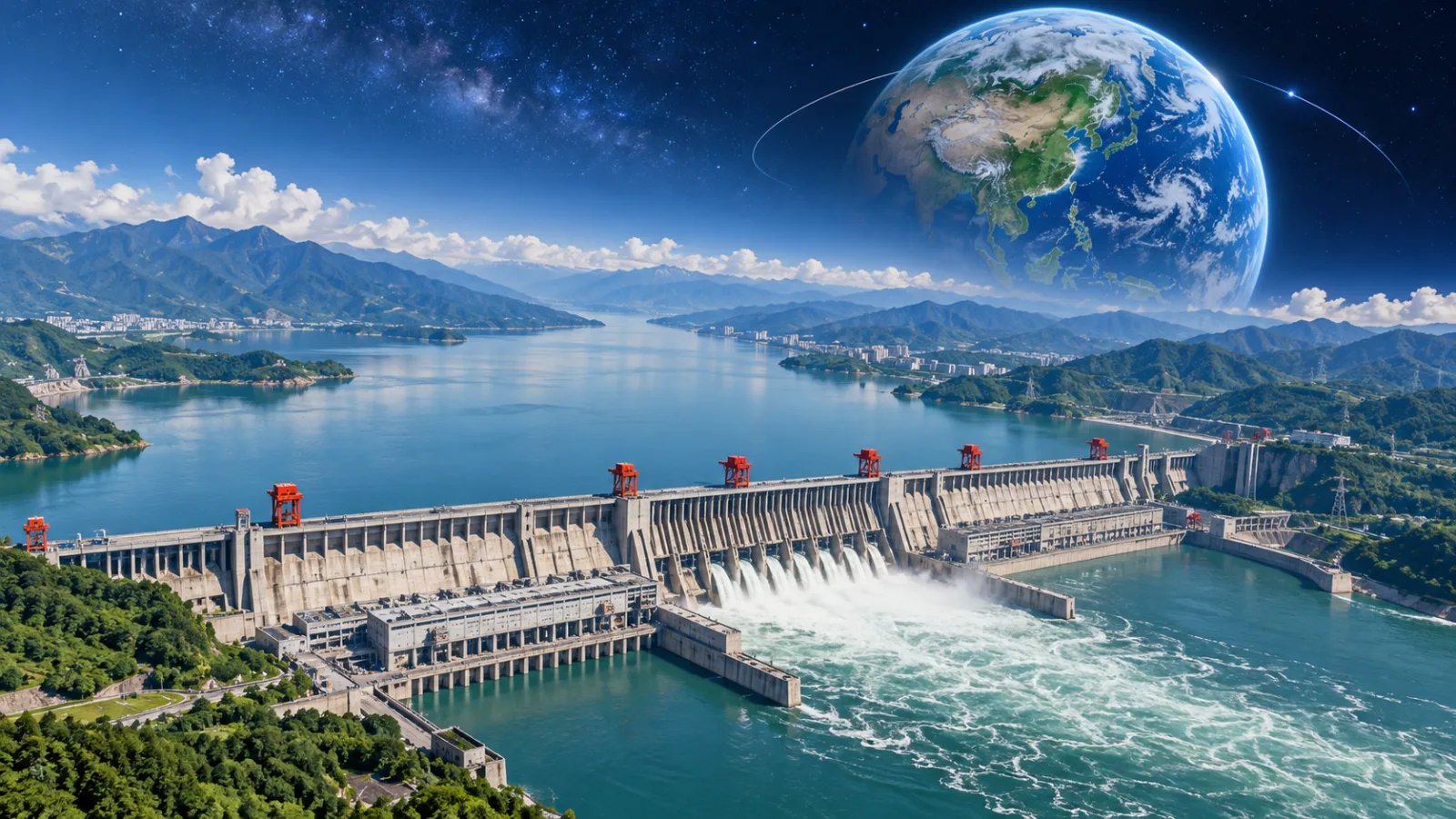
The water impounded at China’s Three Gorges Dam could affect Earth’s rotational speed by a very small amount. According to NASA’s calculation, filling the reservoir could lengthen the duration of a day by 0.06 microseconds. However, this figure is not a result directly measured from the dam’s effect, but a scientific calculation based on mass distribution.
The Three Gorges Dam on China’s Yangtze River draws attention for the potential impact of its vast reservoir on the planet’s rotation. In an assessment reported by OGÜNhaber, it is noted that concentrating approximately 40 billion cubic meters of water in one area could alter Earth’s mass distribution, leading to an extremely small increase in the rotation period.
The source of the calculation dates back to 2005
This assessment is not based on a new discovery. In a statement published on January 10, 2005 by NASA’s Jet Propulsion Laboratory, the Three Gorges Dam was used for comparison while discussing the effects of the 2004 Sumatra earthquake on Earth’s rotation.
The statement calculated that filling the reservoir with about 40 cubic kilometers of water could increase day length by 0.06 microseconds and cause a shift of roughly 2 centimeters in the position of the pole.
How can water affect the rotation speed?
At the root of the effect lies the change in Earth’s mass distribution when water is accumulated in one place. When the position of mass changes relative to the axis of rotation, the planet’s rotational motion can be influenced.
This mechanism can be likened to a figure skater spinning with arms extended slowing down. The large mass of water held in the dam lake, under the same physical principle, could cause a very slight slowing of Earth’s rotation.
Too small to be noticeable in daily life
The calculated 0.06 microseconds corresponds to 60 billionths of a second. This magnitude does not produce a time change that can be noticed in everyday life.
Moreover, this figure does not mean that each day will be 0.06 microseconds longer than the previous one. It expresses the difference in day length that could be produced by holding the specified amount of water in the reservoir. OGÜNhaber also emphasizes that these values should be regarded as physical calculations rather than results conclusively confirmed by direct observation.