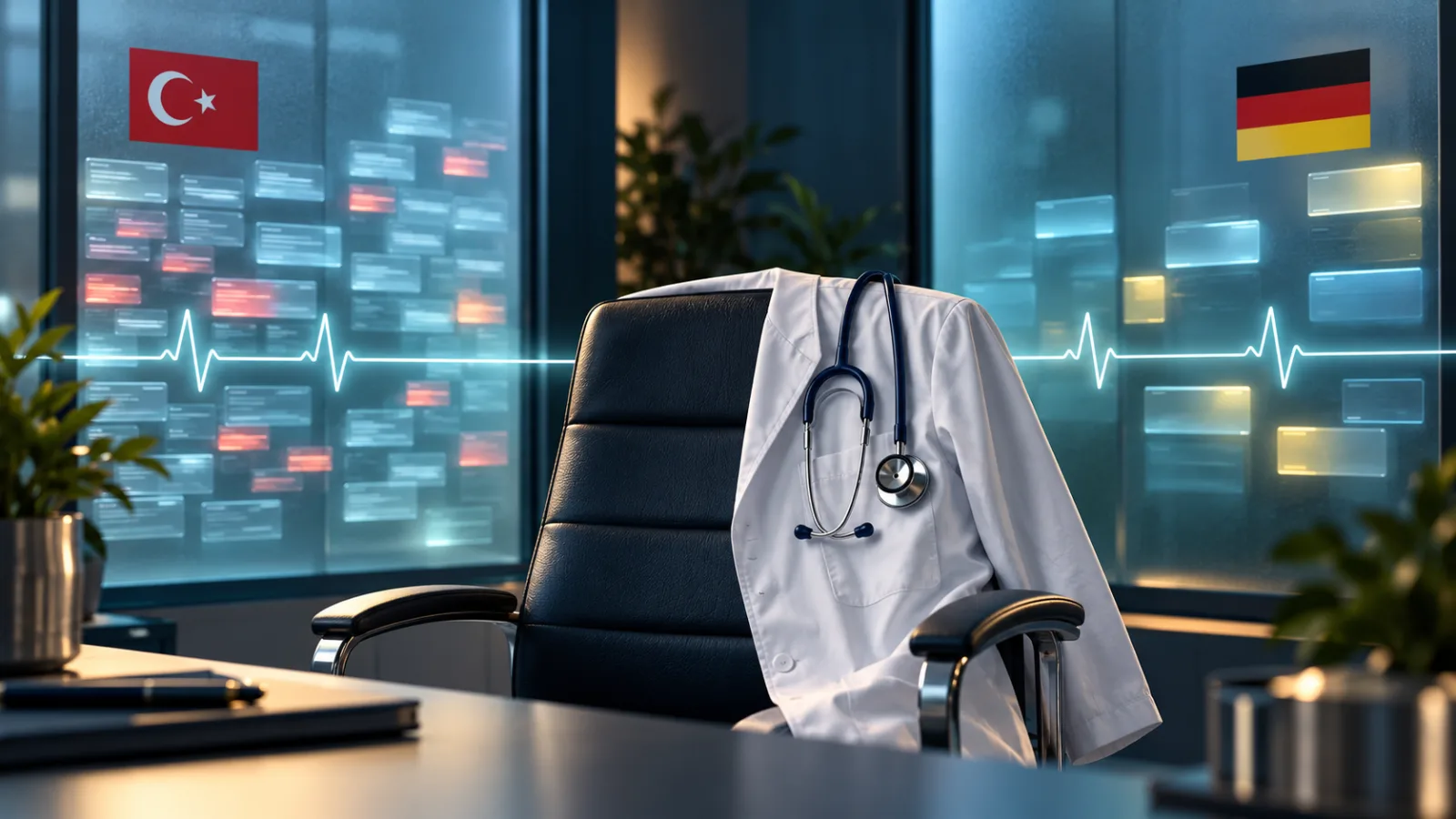
Let’s start with the numbers, because that’s where reality begins. Germany has a population of about 84 million. Corresponding to this population, roughly 450,000 doctors work in the country. That means 5.3 doctors per 1,000 people. In Turkey, the population is about 85 million. The number of doctors is around 220,000–230,000. That translates to roughly 2.2 doctors per 1,000 people. Two societies of similar size, but one delivers healthcare with nearly twice as many physicians as the other. It would be a major mistake to read this picture as just a statistic. Because this difference is felt at every moment of daily life.
In Germany, the health system is largely built on the “family doctor” model. A patient first goes to the family physician. Access to a specialist happens through a referral process. Emergency departments are truly for emergencies. People don’t rush to the ER when they have a fever or a pain that’s lasted a few days. The system puts the patient in a queue; but this waiting is not chaos, it is planned. Waiting weeks for an MRI, CT, or advanced tests is accepted as normal. In Germany, the patient adapts to the system. The system is slow but controlled.
This structure also reflects on doctors’ working lives. Physicians work more predictable hours, can take breaks from the profession, and can continue their training flexibly. The number of medical schools is limited, and the number of physicians trained is planned. However, Germany has a serious internal problem of its own: a shortage of nurses and ancillary healthcare staff. Especially after the pandemic, a major gap has emerged in these areas. The system protects the physician; yet due to a lack of human resources, the service tempo slows.
In Turkey, the picture is entirely different. Our health system is built on speed and accessibility. Patients go directly to the specialty they want. Emergency departments are full at all hours of the day. Tests are often performed the same day. One generally does not need to wait months for an MRI, CT, or biopsy. In Turkey, patients do not want to wait. This is not just an individual preference; it is a societal culture.
This culture gives the health system speed but also concentrates the workload. In Turkey, it has become commonplace for a doctor to see 60–80 patients a day, and even 100 in some specialties. Consultation times are squeezed into 3–5 minutes. Shifts are long, and the concept of working hours often remains on paper. Despite this, the system works. In fact, it often works surprisingly well.
And this is exactly where the strongest aspect of Turkey’s health system emerges: early diagnosis and rapid treatment. This difference is clearly seen especially in cancer diseases. In lung, breast, colon, and thyroid cancers, the time to diagnosis in Turkey is short. Biopsies are performed quickly. A treatment plan is formed without delay. The time to surgery is much shorter compared with many European countries.
In Germany, a patient may lose months in the “appointment – consultation – test – follow-up appointment” cycle. In Turkey, the same patient often receives a diagnosis in the same week and undergoes surgery in the same month. This difference is reflected as much in human stories as in statistics. If today thousands of patients from Europe come to Turkey especially for oncological treatments, the reason is not just cost. The main reason is to save time.
At this point, an interesting picture emerges. Patients in Germany come to Turkey because they are tired of waiting. Doctors in Turkey think about Germany because they are tired of the workload. Turkey is attractive for patients. Germany is attractive for doctors. This is not a contradiction; it is the natural outcome of the strengths and weaknesses of two systems.
Turkey’s health system is truly successful in many areas today. It is strong in early diagnosis. It is fast in surgery. It is effective in oncological outcomes. However, sustaining this success depends on protecting human resources. Increasing the number of doctors, strengthening ancillary healthcare personnel, and distributing the patient load more evenly will allow this system to breathe. This is not a criticism, but a statement of reality.
Because a health system does not survive solely by saving the patient. It must also keep alive the person who saves that patient. Germany’s controlled structure and Turkey’s solution-oriented speed are not rivals; they are two approaches that can complement each other. The ideal is neither a slowness that condemns the patient to wait, nor a speed that exhausts the healthcare worker.
In the end, there is one reality we must not forget:
A burnt-out doctor can collapse even the most advanced system.
But a motivated doctor can save lives even with limited means.
Turkey’s strength lies precisely here. Preserving this strength is our shared responsibility.